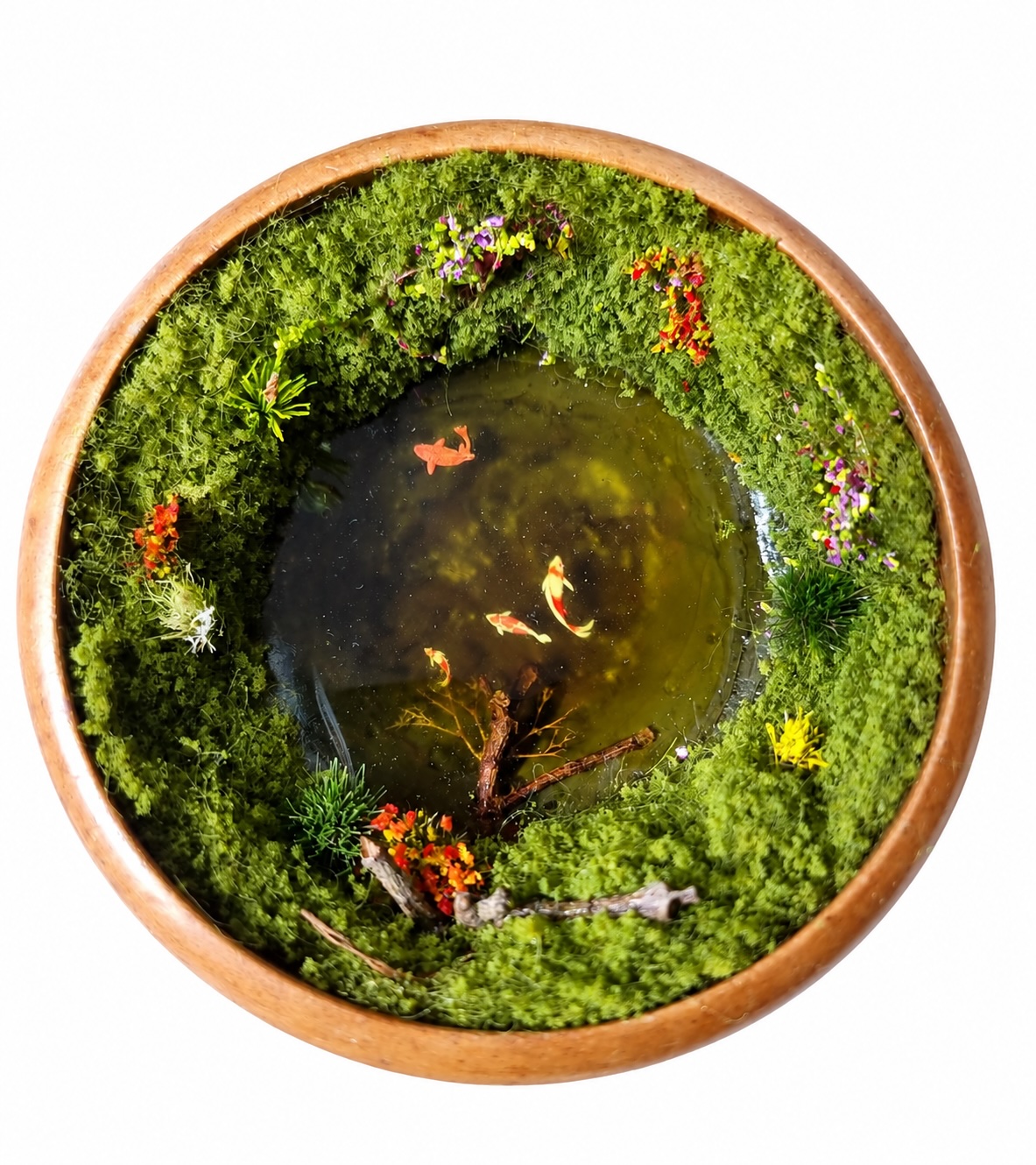
In miniature landscapes, roots do something remarkable — they make time visible.
There's something endlessly fascinating about them. Not the dramatic, towering parts of trees that reach into the sky, but the hidden structures beneath — the parts that grip the earth, push through stone, disappear below the surface of a pond or lake, slowly recording the passage of years.
The weight of history
In miniatures, roots carry a particular power. They convey age without explanation. The moment you introduce exposed roots — twisting around rocks, slipping into soil, or vanishing beneath a pond edge — the entire scene gains character.
It feels established. Settled.
Stitching the scene together
Roots also play an important role in transitions between elements of a miniature scene. In real landscapes, nothing simply stops — soil meets stone, stone meets vegetation, water meets land — and roots often act as the stitching that binds those boundaries together. Introducing them between elements helps remove the artificial "edge" that can sometimes betray miniature work.
You can see this effect in several of my model railway ponds, where the tree on the pond bank not only has a trunk and branches, but roots that visibly disappear below the surface of the water. The same approach carries into the Little World Pieces — one-off builds where each element has to earn its place.
They tie the pond bank and water together, making the whole scene feel whole, organic.
Selecting vs. recreating
There are many ways to create roots. Sculpting and carving can produce excellent results — using an armature covered with viscous glue, for example, convincing trees can certainly be achieved. But over the years I've found myself drawn more and more toward working with small natural twigs when recreating roots.
There's something fundamentally different about using material that already contains nature's complexity. The subtle grain, the gentle taper, the microscopic irregularities formed through seasons of growth — these details exist at a level that is extraordinarily difficult to reproduce convincingly.
Once you begin recognising those qualities, the process becomes less about recreating nature and more about selecting and revealing it.
Much like roots emerging naturally between stones in a wall, something I've incorporated into a few of my lineside hut scenes.
The importance of density
The choice of bush or tree as source material matters more than most people realise. Slow-grown wood tends to have tighter grain, which reads far more convincingly at miniature scale. Young rapid growth often produces softer fibres that flex uncontrollably and tear when cut.
Density matters too. A piece that feels slightly heavier for its size will usually carve more cleanly and hold fine edges without fraying.
A discovery in the garden
I've mentioned my twig-hunting experiences before, including one of my more embarrassing model-making moments. Much of that searching involved examining trees in nearby woodlands. I'm fortunate to live in Surrey, with its many wooded areas and the heavily forested Tillingbourne Valley close by.
After a lot of false starts, though, the material I now use most often came from somewhere much simpler — a woody stem from a thyme bush in the garden.
It wasn't large, but it had a quality that immediately stood out — the kind of thing you recognise instinctively once you've handled enough wood. The growth had been slow, visible in the fine, consistent grain running along its length. There was a natural taper — gradual, unforced — the result of steady development without competing shoots. When flexed gently, it had that reassuring firmness: seasoned enough to be stable, but not brittle.
Capturing surface character
What really caught my attention was the surface character. The bark wasn't deeply ridged, but it carried fine linear undulations — subtle texture that reads beautifully when incorporated into a scaled scene. It had the kind of restrained complexity that catches washes and pigments naturally, without needing artificial enhancement.
You can't convincingly reproduce that sort of detail. You either recognise it when you see it, or you don't.
I picked it about three years ago, soaked it in glycerine, applied a gentle wash, and left it to dry for several weeks. Since then I've been using small sections of it for roots, and it has become one of my favourite materials — although I'm starting to run out now and will soon have to spend time in the garden finding more.
Working with the grain
Working with it taught me something else as well. Wood looks and behaves very differently depending on how you approach it.
Cutting along the grain allows the fibres to separate naturally rather than tear, preserving the taper and avoiding blunt ends that immediately betray the scale. Those natural splits also take stain beautifully, gently exaggerating texture in an uneven, realistic way.
Understanding how roots grow also helps when placing them. They favour paths of least resistance, working slowly through softer material and diverting around harder obstacles. They thicken where stresses accumulate and taper according to age and load. Introducing that underlying logic — rather than random chaos — is what makes them convincing.
Even slight asymmetry in spacing or thickness can dramatically increase realism — traits I also looked for when selecting my garden twig. Sea foam works well here too. Pressed into the main branches, small pieces add texture and deepen the irregularity in a way that feels entirely natural.
Occasionally I'll soak pieces in glycerine again before use. This softens the otherwise brittle nature of thyme just enough to introduce a gentle bend before they're fixed in place around stones and other obstacles. Once dry, they settle into curves that feel as though they've grown there over years rather than been positioned in a single afternoon. A gentle wash then brings out the colour and fine ridges.
The narrative of persistence
What I enjoy most is the gentle irregularity roots introduce. They rarely follow straight lines. They bend, divide, twist, and disappear. That controlled unpredictability is incredibly valuable in miniature work, where artificial materials can otherwise look overly deliberate.
There's also a quiet narrative quality to them. Roots imply persistence. Survival. Time passing unnoticed.
A wall with roots feels older than a wall without them.
A tree with exposed roots feels heavier, more grounded.
A pond with roots entering the water feels connected to a wider ecosystem.
It's a small detail, but one I return to often in my own miniature landscapes because it changes how the whole scene is perceived.
Sometimes the smallest additions carry the greatest sense of realism.
And occasionally, it begins with a twig you knew was special the moment you picked it up.