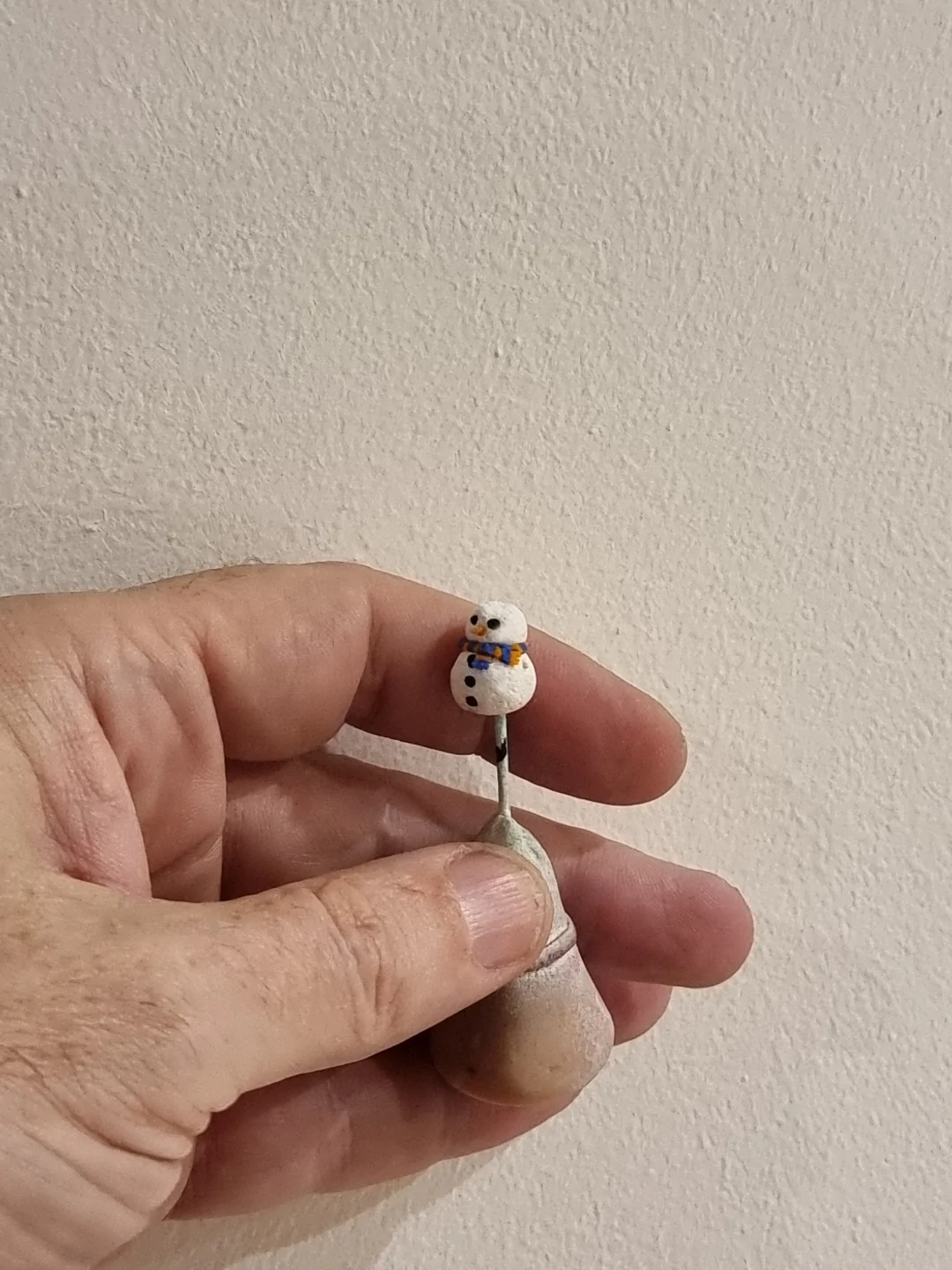
Several years ago I made a small run of OO gauge snowmen. Two stacked spheres, twig arms, a carrot nose. Nothing elaborate — I remember knocking the first batch out on a quiet evening and being quietly pleased with how they turned out. They had a slightly wonky quality that I hadn't entirely planned for, but which suited them perfectly. People responded to that. I think there's something about a handmade figure at that scale that rewards a little imperfection — it reads as alive rather than manufactured. They sold well, I moved on to other things, and somehow they never came back the following year. Or the year after that.
This November I've been sitting with the fantasy pieces more than usual — the cloches, the mushrooms, the small glass worlds that have been occupying most of my bench time. There's a particular kind of focus that comes with that work, a close attention to how something reads at a few inches' distance, and I think it's changed how I look at everything else I make. So when the temperature dropped and I found myself thinking about the snowmen again, the first question wasn't can I make these — it was what would they look like if I brought the same level of attention to them that I've been giving everything else lately.
The challenge with revisiting something you've made before is that you carry a memory of what worked. The original snowmen had that wonky charm precisely because I wasn't overthinking them — and that's a quality that can't survive a mould. The figures you find in bulk bags, cast from the same tool a thousand times over, have a kind of blankness to them. Every irregularity sanded away in the design stage. Coming back to these with more technique and more intention, there was a real risk of doing the same thing to myself — ironing out the very thing that made them good. I made several early versions that were technically more accomplished and entirely less appealing — too smooth, too considered, too aware of themselves. I scrapped those and started again with that problem in mind rather than the solution.
The ones that came through that process have more going on than the originals. A clay scarf twisted from two colours. A small candy cane. A surface texture that reads like packed snow rather than shaped putty. But the character is still there — nothing about them is perfectly symmetrical, and I think that's right. At OO gauge, a figure you can hold between your finger and thumb, a little imperfection isn't a flaw. It's what makes it feel like it belongs in a scene rather than sitting on top of one. There are a small number in the shop, each one slightly different from the next. They won't come back in quite this form.