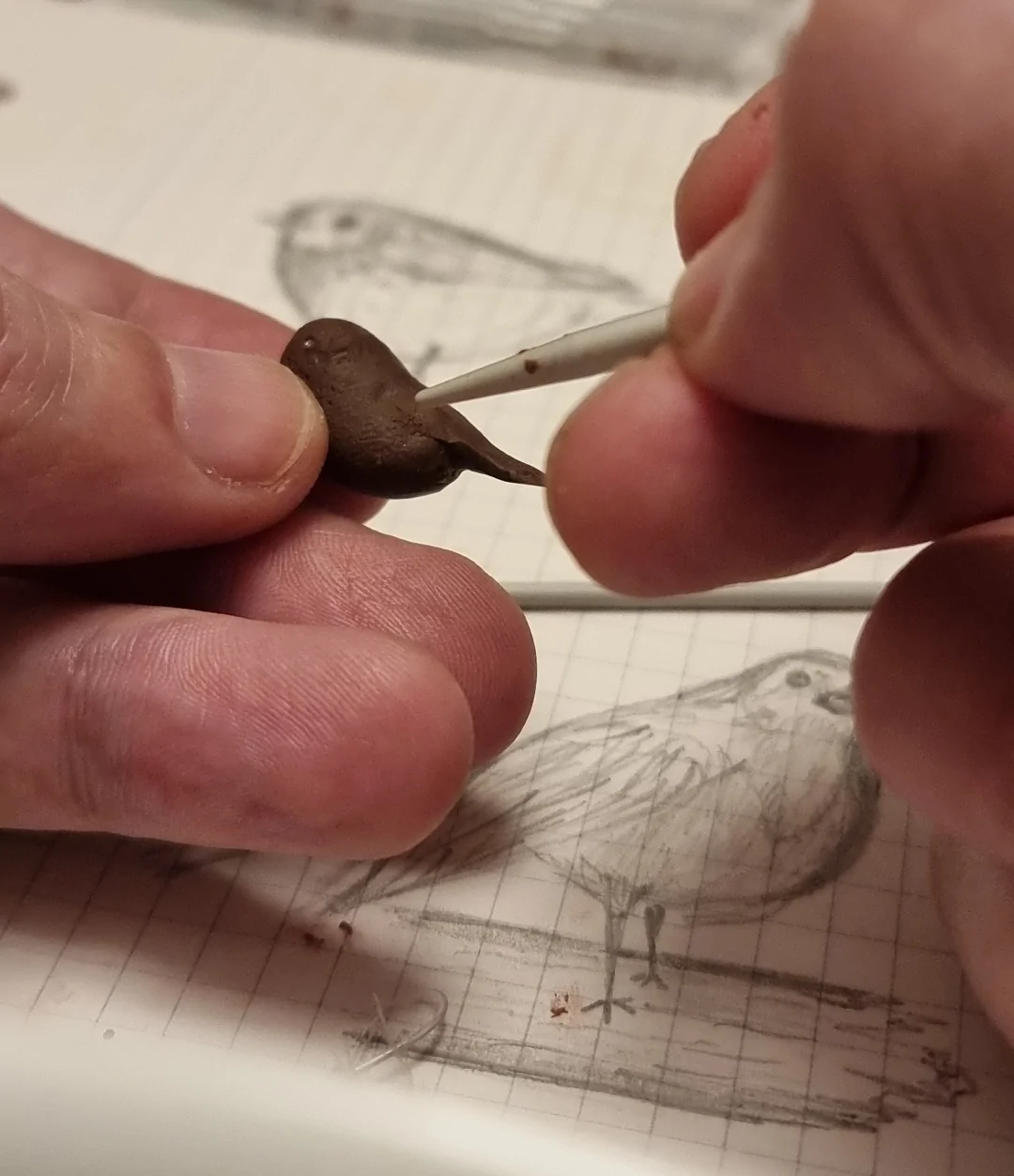
Every workbench ends up with a few things that weren't planned — tools that weren't chosen so much as kept.
Not the tools you go out and buy, but the ones that stay — picked up once, used without much thought, and then somehow becoming part of how things get made.
Looking across mine, there's a small collection that don't really belong there at all. And yet they're the ones I reach for most often.
Not because they're clever, but because they make it easier to work without forcing things.
A Cocktail Stick That Refuses to Retire
There's always one.
Worn down, slightly stained, and used far longer than it was ever meant to be.
It's what I reach for when something needs nudging rather than placing. A touch of glue, a slight shift, a detail eased into position instead of set down too neatly.
Used carefully, it stops things from feeling overdone — just enough movement to let them settle properly.
The Brush That's Long Past Its Best
At some point, a decent brush stops being useful for painting.
After that, it becomes more useful.
It's used to soften edges, blend materials, and take the edge off anything that's become a bit too clean or too certain of itself. It helps bring things together so they don't feel separate.
The good ones don't get thrown away. They just change jobs.
A Small Piece of Blu Tack
Usually found close to hand, and often falling on the floor.
It holds things just long enough to decide whether they're right — a figure, a detail, a small adjustment that might otherwise be fixed too soon.
It's a way of not committing straight away — giving something a moment to prove itself before it becomes permanent.
A Piece of Sponge
Never chosen, always found.
It's useful for breaking things up — surfaces that feel too even, too deliberate, too controlled.
Used lightly, it introduces just enough variation to take the edge off. Too much and it shows immediately. Just enough and it disappears into the piece.
Which is usually where it works best.
A Soft Cloth
Sometimes the most useful thing is being able to take something back.
A quick pass can soften an edge, lift excess, or reduce something that's become a bit too defined.
It's easy to keep adding. To keep improving, or at least thinking you are. The cloth does the opposite.
And more often than not, the piece is better for it.
A Mug of Tea
There's one mug that seems to have settled into the workbench over time.
It's been there long enough to pick up its own marks — a faint ring, a couple of chips, traces of whatever has been worked on nearby. It belongs there now.
It's rarely empty, and almost never finished.
It creates a natural pause. Make a change, step back, pick it up, look again.
And it's often in that moment — not while working, but just after — that something either settles into place, or quietly doesn't.
Letting the Tools Get Out of the Way
None of these are remarkable.
They're not the sort of tools you'd think to mention, and they're certainly not the reason a piece works.
They just make it easier to slow things down — to adjust, to step back, to change something before it's too late.
Because the aim isn't to show how something was made.
It's to create something that feels as though it's always been that way — a small piece of a place that holds together, even when you look a little closer.
The tools just help get it there.
Carefully, and without needing to make a point of it.